| Linguistics |
| Actual scientific name : |
|
Crocidura hirta |
| |
|
|
| Old scientific name : |
|
|
| |
|
|
| French name : |
|
Petite Crocidure Rouge |
| |
|
|
| English name : |
|
Lesser Red Musk Shrew |
| |
|
|
| Vernacular name : |
|
|
| |
|
| Zoology |
| Call : |
|
|
| |
|
|
| Description : |
|
Measures between 13 and 15 cm (with a tail of 5 cm) and weighs 20 g. Brownish-fawn on the upperparts and slightly lighter on the underparts. Musk shrews have a long, thin and tapered snout covered with sensorial hairs (vibrissae). Eyes are small and ears are round. Tail is sparsely covered with prominent vibrissae. |
| |
|
|
| Habitat : |
|
Forests, savannah, plains. |
| |
|
|
| Behaviour : |
|
Musk shrews have a fast metabolism and ingest, per day, a quantity equivalent to the double of their mass. Crocidura hirta is mostly nocturnal but also active at dawn and at dusk. Musk shrews are very active, constantly moving their snouts to search for food in the ground. Live solitary and actively defend their territories.
Live for about 18 months. |
| |
|
|
| Diet : |
|
Invertebrates (including worms), small rodents. Also eat part of their excrements. |
| |
|
|
| Life history : |
|
After a gestation period of 20 days, females give birth to a litter of 2 to 5 young. |
| |
|
|
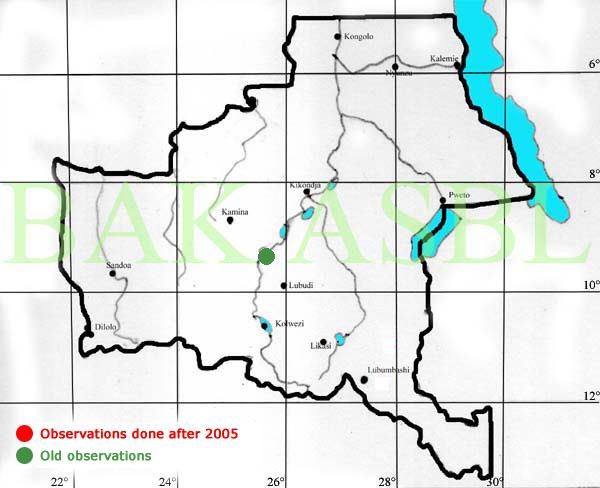
| Distribution in Katanga : |
|
 |
| |
| |
| History, Ethnology, Sociology |
| Interactions with humans : |
|
|
| |
|
|
| Taboos : |
|
|
| |
|
|
| Legends, believes, folklore : |
|
|
| |
|
|
| Fishing, hunting : |
|
|
| |
|
|
| Feeding : |
|
|
| |
|
|
| Breeding, taming : |
|
|
| |
|
|
| Uses of skin or other body parts : |
|
|
Warning :
This database was established according to official pieces of work and with the help of famous scientists. However, there might be some errors.
The vernacular names were collected in the field and in the colonial literature from the first part of the 20th century. The monks who established the first dictionaries were not necessarily informed naturalists. Therefore, errors must have been committed.
We invite everyone who could help us to improve this working tool to contact us in order to correct us and share her/his knowledge with us.
+ You are in :
ROOT > Vertebrata (Vertebrates) > Mammalia (Mammals) > Insectivora (Insectivores) > Soricidae (shrews)
|


 Design by McArnolds Group SA | Development and code by AMESIS SPRL